
Governed AI agents

AI that reads your files, flags risk, and briefs your reviewers, under your rules, your permissions, and the model you choose. The human always makes the final call.
Book a demo

Trusted by leading companies across regulated industries

Why AI agents matter for regulated review now
For years, AI was not good enough, or safe enough, to touch regulated content. That has changed, for four reasons.

Capability. Frontier models now perform at a useful level on the kind of reasoning regulated review requires, and they keep improving.

Economics. Analyzing a document with a frontier model now costs a fraction of what it did two years ago, which makes checking files one by one practical at scale.

Deployability. The reliable way to get results today is to engineer and test prompts on a strong model, not to train a custom one. That is exactly how Aproove builds its agents.

Mandate. Regulators increasingly expect you to produce any asset on demand and prove who approved it and when, and to stand behind work produced on your behalf by agencies and vendors.

When we asked health-plan marketing leaders what keeps them up at night, the top answers were all the same fear in different clothes: can we prove how we made our decisions?


Pixelated gradient background transitioning from blue at the bottom left to green at the top right.
Gradient background transitioning from pink in the upper left corner to yellow in the lower right corner with a pixelated texture.
Gradient background transitioning from green at the top to yellow at the bottom with a subtle pixelated texture.

What an AI agent does in a proofing workflow

An AI agent in Aproove reads the content of a file: the text, the images, the color, and any metadata.

It checks that content against rules you define, whether regulatory requirements, brand guidelines, external norms, or specific instructions. Then it acts on what it finds.

That is enough to change how a review starts.

AI-led risk analysis at the component level

When a file is uploaded, Aproove processes it, analyzes and rips it securely, and streams it. The file is broken into its components and made available to people and to AI. That is what makes secure AI analysis possible. The agent works from the same component-level understanding of the file that your reviewers do, inside the secure environment, without the file being downloaded or handed off.

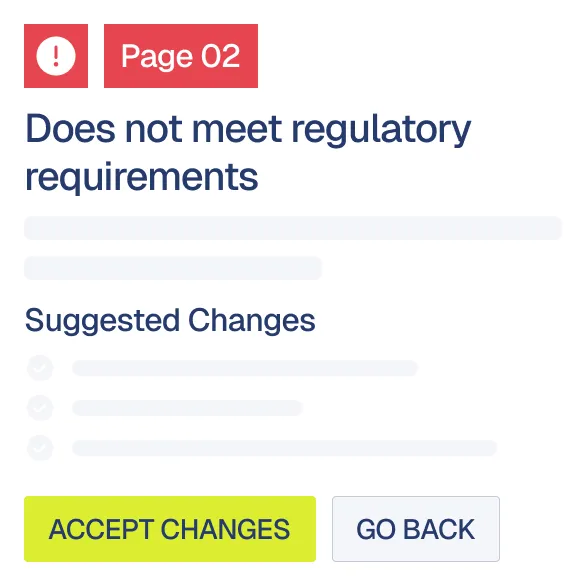
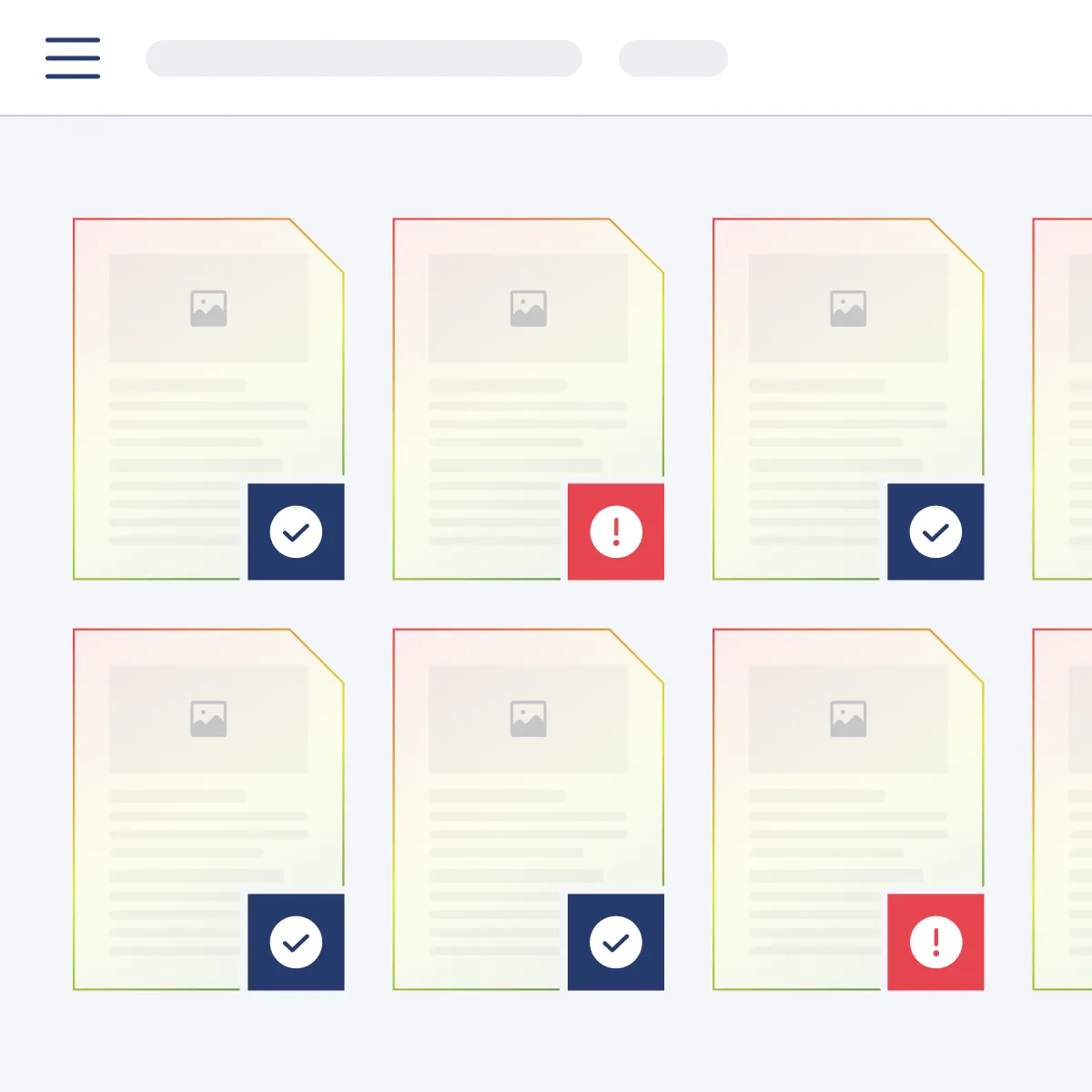
Because of that, an agent can analyze a file for risk before a human opens it. It tags the risk at the page or component level, then routes the file to the right experts.

Reviewers are brought in with context and pointed at what needs them, which saves time and means decisions are made in context, not cold.

The human always makes the decision

Aproove is decision-based. To move a workflow forward, a human has to make an auditable decision. The agent can assist, flag, and suggest, but it cannot decide. Every approval belongs to a person, and every decision is recorded.

The agent flags. The right person decides. In regulated work, that line does not move.

Use the model of your choice, even a different one per task

Aproove has an open model philosophy. Choose your frontier model. ChatGPT and Claude work out of the box, or you can bring your own model.

You also get model flexibility inside a single workflow. You might run a spelling and grammar check with one model, a regulatory check with another, and a brand-guideline check with an in-house model, each agent matched to the task it does best.

No single model is best at everything, so committing to one would cost you either quality or money.

Governed by your permissions, run automatically or on demand

Agents can run automatically inside a workflow, or be called by a person when they are needed.

Agent permissions follow your workflow permissions, which are strict and flexible. Agents are only available at the right tasks, and only the right people or teams can see and run the right agents. You decide who runs which checks, on which assets, at which step. Every action an agent takes is logged, so the AI operates inside the same record as everyone else.

What changes

1

Your reviewers stop reading every file from scratch. The routine, mechanical checks are flagged before they open it, so they spend their time on judgment: whether a claim is defensible, whether the intent is right.

2

The work moves faster. Risky content surfaces earlier. And because the AI runs under your rules, your model, and your record, you can still prove exactly how every decision was made.

Audit-ready at a moment’s notice.

Aproove makes accuracy, speed and scale realistic for regulated content.

Book a demo
Abstract blurred gradient background blending green, blue, and yellow colors.